Mar
As factories scale and data volumes grow, slow, unstable, or congested communication links create bottlenecks that delay diagnostics, increase downtime risk, and reduce overall productivity.
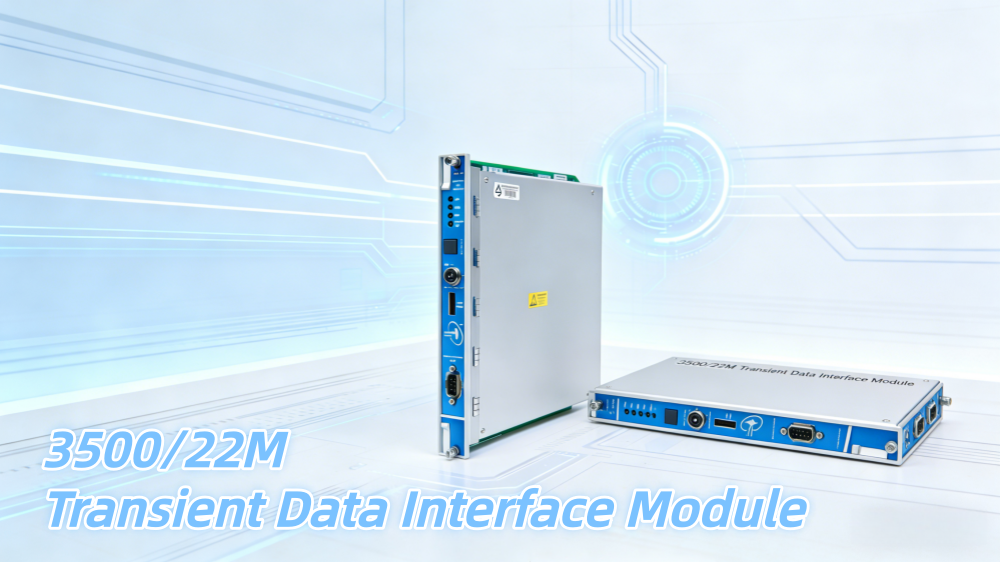
The 3500/22M Transient Data Interface (TDI) module from Bently Nevada is purpose-built to resolve these limitations, supporting high-speed, reliable, and scalable communication for critical rotating machinery monitoring systems.
This article explains how the 3500/22M eliminates communication bottlenecks and improves industrial data flow.
Industrial communication bottlenecks typically appear in four forms:
1. Slow data throughput: Insufficient bandwidth for high-resolution vibration, waveform, and transient data.
2. High latency: Delays in transmitting real-time alerts and dynamic machine signals.
3. Protocol incompatibility: Inability to connect monitoring hardware to DCS, SCADA, or cloud platforms.
4. Unreliable connections: Interruptions caused by non-redundant links or electromagnetic interference.
Unaddressed, these issues can lead to delayed fault detection, inefficient maintenance, and unexpected shutdowns.
Studies show that communication delays in critical machinery monitoring can increase unplanned downtime by 25%–40% in heavy industry sectors including power generation, oil and gas, and petrochemical processing.
The 3500/22M is designed as an integrated communication and data interface for the 3500 machinery protection system.
It combines rack interface functionality with high-speed data processing to streamline end-to-end data flow.
The module supports 10/100 Mbps auto-sensing Ethernet and optional 100Base-FX fiber-optic connectivity, enabling stable high speed transmission. With a dedicated data path, it supports:
· Sampling rates up to 100,000 samples per second
· Reliable transfer of steady-state and transient waveform data
· Low latency delivery of vibration, temperature, speed, and position signals
This eliminates bottlenecks caused by limited bandwidth or slow sampling.
The 3500/22M uses open and industry-standard protocols to connect seamlessly with upper-level systems:
· Modbus TCP
· BNN host and TDI protocols
· SNMP, SNTP, and IEEE 1588 PTP time synchronization
· Direct integration with System 1 condition monitoring software
This removes protocol barriers and simplifies data integration without gateways or converters.
Dual independent Ethernet ports support network redundancy, ensuring:
· Zero data loss during failover
· Continuous communication in harsh industrial environments
· Compliance with SIL2 safety requirements for critical applications
Redundancy directly reduces downtime caused by single point network failure.
The 3500/22M pre-processes data locally before transmission, reducing network load:
· Filters non-critical data
· Prioritizes alarms and transient events
· Supports configurable update rates down to 100 ms
By reducing unnecessary packet traffic, the module prevents congestion and improves responsiveness.
|
Parameter |
Value |
|
Communication Interface |
Dual 10/100 Mbps Ethernet; optional fiber |
|
Supported Protocols |
Modbus TCP, BN Protocol, SNMP, PTP |
|
Sampling Rate |
Up to 100,000 samples per second |
|
Data Update Rate |
Configurable down to 100 ms |
|
Operating Temperature |
-40°C to +85°C |
|
Power Consumption |
10.5 W |
|
Compatibility |
3500 series racks, M series monitors |
Deploying the 3500/22M delivers measurable operational improvements:
· Lower latency: Real-time data cuts diagnostic response time
· Higher throughput: Supports full waveform and transient data without congestion
· Simplified integration: Direct connectivity to DCS, SCADA, and cloud platforms
· Improved reliability: Redundant links increase uptime
· Lower maintenance cost: Predictive data reduces unplanned shutdowns
Users report that after upgrading to 3500/22M, communication stability improves by 35%–50% and data delivery latency drops by more than 40%.
Industrial communication bottlenecks threaten productivity, safety, and equipment lifespan.
The 3500/22M Transient Data Interface solves these challenges with high-speed transmission, multi-protocol support, redundant networking, and intelligent data filtering.
By enabling reliable, real-time data flow between machinery monitoring systems and control platforms, the 3500/22M strengthens operational transparency, supports predictive maintenance, and boosts overall plant efficiency.
For facilities seeking stable, high-performance communication in machinery protection, the 3500/22M remains a trusted, proven solution.
For technical specifications, availability, and procurement of Bently Nevada 3500/22M modules, contact:
Amikon Limited
Sales Manager: May
Email: sales5@amikon.cn

Mon - Fri 8:00AM - 6:00PM Central Time